Turmeric Export from India: Grades, Prices & Global Market Guide
Grades, curcumin specs, price benchmarks, and global market opportunities for Indian turmeric
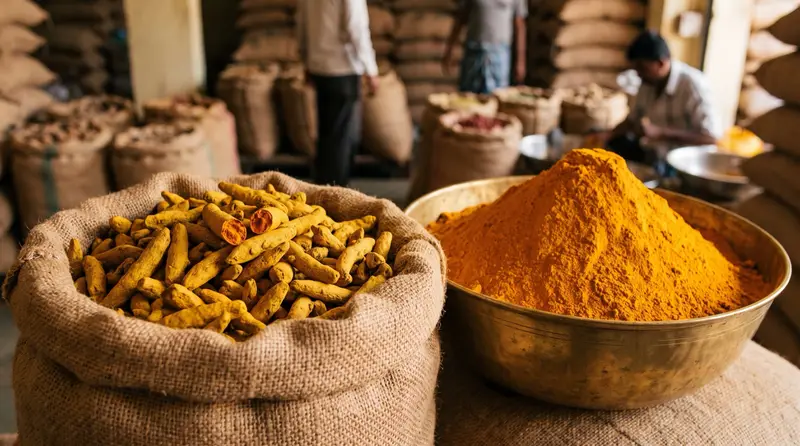
India is one of the world's most dynamic agricultural export markets — and spices are its crown jewels.
India accounts for nearly 70% of global turmeric production — a spice that has been at the heart of Indian agriculture and trade for thousands of years. From the fertile fields of Erode in Tamil Nadu to the agricultural heartland of Sangli in Maharashtra, Indian turmeric is the benchmark against which all other origins are measured.
For international spice buyers — whether you're a food processor in the UAE, a spice trader in Bangladesh, or a pharmaceutical company in Japan — understanding how to source, evaluate, and import Indian turmeric is critical to your supply chain. This guide covers everything you need to know.
Understanding Indian Turmeric Varieties & Growing Regions
India's turmeric production is concentrated in specific agro-climatic zones that produce distinct quality characteristics:
Erode Turmeric (Tamil Nadu)
Erode in Tamil Nadu is often called the "Turmeric Capital of India". Erode turmeric is known for its deep color, high curcumin content, and excellent aroma. The Erode variety typically commands the highest premium in international markets.
Sangli Turmeric (Maharashtra)
Sangli in Maharashtra is another major turmeric-growing region. Sangli turmeric is valued for its consistent color and moderate curcumin levels. It is often preferred for its slightly lower price while maintaining good quality.
Nizamabad Turmeric (Telangana)
Telangana's Nizamabad region is one of the largest producers of turmeric in India. The variety is known for bulk yield and reasonable curcumin content, making it popular among industrial buyers and food processors.
Rajapuri Turmeric (Karnataka)
Rajapuri turmeric from Karnataka is known for its exceptionally bright color and is often preferred by buyers in the Gulf and Middle East markets.
Turmeric Export Grades — What Each Means
Indian turmeric is graded primarily by the Spices Board of India under the IS:3327 standard. The main grades available for export:
- Special Grade (Alleppey Supreme): Curcumin content 5%+, moisture under 10%, light-spotted or better. The premium export grade.
- Good Grade: Curcumin 3.5–5%, moisture under 10%. Most commonly traded export grade.
- Fair Average Quality (FAQ): Minimum export standard — curcumin 3%+, moisture 10%. Used for bulk orders where price is the primary driver.
Beyond these official grades, buyers frequently specify custom parameters:
- Curcumin content: The active compound that gives turmeric its color and value. Higher curcumin = higher price. International buyers typically specify 3% minimum, with premiums for 4%+ and 5%+.
- Color value: Measured as ASTA (American Spice Trade Association) color units — typically 450–600 ASTA for good Indian turmeric.
- Moisture: Under 10% for safe sea freight storage. Above 12% risks mold and microbial growth.
- Foreign matter: Should be under 1% for clean export cargo.
- Broken/extra long: Specification on percentage of broken fingers in the consignment.
Turmeric Price Benchmarks — India 2026
Indian turmeric prices are quoted per quintal (100 kg) or per MT in INR, with USD equivalents based on the INR/USD exchange rate. Key price determinants:
- Curcumin content (higher = premium pricing)
- Origin variety (Erode commands highest premium)
- Crop year (new crop vs. old crop)
- Seasonal supply from key growing regions
- Export demand from key markets (UAE, Bangladesh, Iran, USA)
- INR/USD exchange rate
As of mid-2026, indicative prices for Indian turmeric FOB JNPT:
- Erode Special Grade (5%+ curcumin): USD 1,850–2,150 per MT
- Good Grade (3.5–5% curcumin): USD 1,500–1,750 per MT
- FAQ Grade (3%+ curcumin): USD 1,200–1,450 per MT
Note: Prices fluctuate with the crop cycle. New crop arrives in January–February (Nizamabad) and March–April (Erode), typically causing seasonal price corrections.
Top Buyer Markets for Indian Turmeric
UAE (Dubai, Abu Dhabi): The UAE is the largest Middle Eastern buyer of Indian turmeric. Dubai's spice markets (Deira) serve as a re-export hub for Iran, Saudi Arabia, East Africa, and Europe. Most UAE buyers purchase 3–5% curcumin grade.
Bangladesh: A major buyer of Indian turmeric — both for domestic consumption and re-export. Bangladesh buyers typically focus on FAQ and Good Grade varieties for cost competitiveness.
Iran: Significant buyer of Indian turmeric, though payment challenges (due to sanctions) require careful structuring. Iranian buyers typically purchase in bulk via UAE trading houses.
USA: The American market prefers higher curcumin content (5%+ for food applications) and clean, machine-cleaned turmeric fingers. Organic turmeric is a growing niche.
Japan & South Korea: These markets have strict quality requirements — specific curcumin content, low microbial load, and detailed pesticide residue testing.
European Union: EU buyers require rigorous documentation including pesticide residue testing, heavy metal testing, and sometimes organic certification. Erode turmeric is preferred for EU food grade applications.
Packaging Options for Turmeric Export
Indian turmeric for export is packed in several formats depending on buyer requirements:
- PP Bags (Polypropylene): Most common — 25 kg, 50 kg bags. Cost-effective and widely accepted.
- Jute Bags: 25 kg or 50 kg. Preferred by buyers in some Middle Eastern and African markets. More expensive than PP.
- Bulk Bags (FIBC): 500 kg to 1 MT big bags — used for container stuffing. Efficient for large orders.
- Consumer Packaging: For retail-ready orders — 100g, 200g, 500g pouches with buyer's branding. Requires additional processing and custom clearance in destination country.
Documentation for Turmeric Export from India
- Bill of Lading: Maritime transport document
- Commercial Invoice: With full product specifications
- Packing List: Bag-wise breakdown
- Certificate of Origin: From FIEO or Chamber of Commerce
- Phytosanitary Certificate: Required by most destination countries
- Fumigation Certificate: Confirming pest-free status
- Spices Board Certificate: Quality certification from the Spices Board of India
- ASTA Color Test Report: Independent lab testing for color value
- Curcumin Assay Report: Third-party lab verification of curcumin content
Key Tips for Turmeric Buyers
Always specify curcumin minimum: "Good quality" is not a specification. Always state a minimum curcumin percentage (e.g., "minimum 3.5% curcumin") in your purchase contract.
Order during new crop: January–April is when new crop turmeric becomes available — prices are typically lower and quality is at its peak freshness.
Request ASTA color test: A buyer in the UAE or Bangladesh should always request an ASTA color test report from an independent Indian lab. This protects against color dilution claims.
Check moisture carefully: Turmeric with moisture above 10% risks mold during sea freight, especially in high-humidity conditions. Always specify maximum moisture in your contract.
Understand the crop cycle: Turmeric prices are seasonal. The post-harvest period (April–June) typically offers the best pricing before库存 pressure eases.
Need a Turmeric Export Quote?
TGK Agro supplies export-grade Indian turmeric sourced from Maharashtra and Telangana. We provide curcumin assay reports, ASTA color certificates, and full export documentation for buyers in the UAE, Middle East, and globally.
Request a Quote →