Cotton Bale Price in India: How a 170 kg Bale Is Priced
From candy rates to a landed quote: the numbers behind a bale of Indian cotton
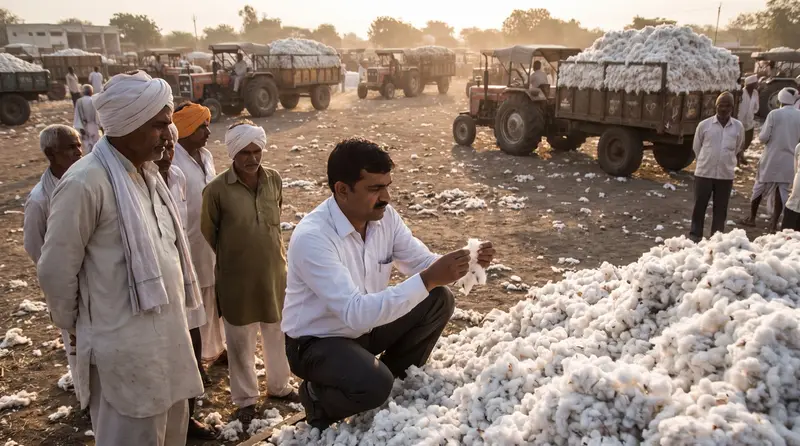
"How much is a bale of cotton?" is the most common question buyers ask an Indian exporter, and the honest answer is that it depends on four things: the unit the price is quoted in, the variety and fibre quality, the point of delivery, and the time of year. This guide explains how Indian cotton is priced, how to convert a market quote into a per-bale figure, and what to specify to get a firm offer.
What a bale of cotton is in India
An Indian cotton bale is a pressed block of ginned lint with a standard net weight of 170 kg. That is lighter than the US bale, which weighs about 218 kg (480 lb net), so a "bale" is not a universal unit and a price per bale from one country cannot be compared with another without converting to weight.
Two other units appear in Indian trade:
- Candy: 356 kg of lint, the unit in which ginned cotton is quoted between ginners, traders and mills. One candy is roughly 2.1 bales.
- Quintal: 100 kg, the unit for kapas (raw seed cotton) at APMC mandis before ginning, and the unit in which the government announces the minimum support price.
International benchmarks such as the Cotlook A index and ICE futures are quoted in US cents per pound.
Converting a market quote into a bale price
The conversions are simple arithmetic once you know the units.
| From | To a 170 kg bale |
|---|---|
| Rupees per candy | Candy rate multiplied by 170 and divided by 356 (about 0.4775 of the candy rate) |
| Rupees per quintal of lint | Quintal rate multiplied by 1.7 |
| US cents per pound | Cents per pound multiplied by 374.8 (the pounds in 170 kg), then converted to your currency |
An illustrative example, not a live quote: if Shankar-6 lint trades at 56,000 rupees per candy, a 170 kg bale costs about 26,700 rupees ex-gin. Convert at the rupee-dollar rate of the day, then add pressing, transport and export costs described below. Our indicative prices section shows reference values; a firm price is always quoted against your specification.
What moves the price of Indian cotton
Variety and fibre quality
Shankar-6 from Gujarat and Maharashtra is the benchmark export variety. MCU-5 commands a premium for its longer staple, and DCH-32 for its fine, long fibre. Within a variety, price steps with the test results: staple length, micronaire, fibre strength, trash content and moisture. Contamination-free lots earn a further premium from spinning mills. The full specification range is on our cotton bales page.
Season and arrivals
Indian cotton arrives from October to March. Prices are usually softest when arrivals peak between November and January and firm up from April as ginners' stocks thin out. Contracting during peak arrivals and shipping over the following months is the normal way to secure a good average price.
Government procurement
The minimum support price for kapas sets a floor. When market prices fall to it, the Cotton Corporation of India buys, which supports lint prices for the rest of the season.
Global prices and currency
Indian lint tracks international benchmarks with a lag, and the rupee-dollar rate changes the dollar price of a bale even when the rupee price is unchanged. Mills buying in dollars should agree the currency and the fixing date in the contract.
From ex-gin to a landed quote
A bale price quoted ex-gin is not what you pay at your port. The usual additions are:
- Pressing, wrapping and strapping to export standard, with bale marking to your specification.
- Inland transport from the ginning belt to JNPT Mumbai, including container stuffing.
- Export documentation: commercial invoice, packing list, certificate of origin, phytosanitary and fumigation certificates, and the fibre test report.
- Ocean freight and insurance, depending on whether you buy FOB, CFR or CIF.
A 40-foot container carries roughly 150 pressed bales, about 25 tonnes, so quotes are normally built per container load.
How to get a firm price from an exporter
Send these six points and you will get a usable quote within a day:
- Variety and grade, for example Shankar-6 29 mm.
- Required staple, micronaire and strength range.
- Quantity in bales or containers.
- Destination port and incoterm.
- Shipment window.
- Payment terms: letter of credit or wire transfer.
Frequently asked questions
How many kilograms are in one bale of cotton in India?
170 kg net. A candy is 356 kg, and a quintal is 100 kg.
Is cotton priced per bale or per candy?
Ginners and traders quote per candy; exporters convert to per bale, per tonne or per pound for overseas buyers.
When is Indian cotton cheapest?
Usually during peak arrivals from November to January, though quality lots command premiums even then.
Can you fix a price for later shipment?
Yes, against a confirmed order and payment instrument. Forward pricing is normal for shipments spread over several months.
Need a bale price against your specification?
Tell us the variety, quantity and destination and the export desk will quote within one working day.
Request a quote